When Does The New Year Start In The Jewish Calendar. The civil year or civil calendar is determined from tishri. The jews celebrate their new year in the autumn on the first day of tishri, the seventh month.
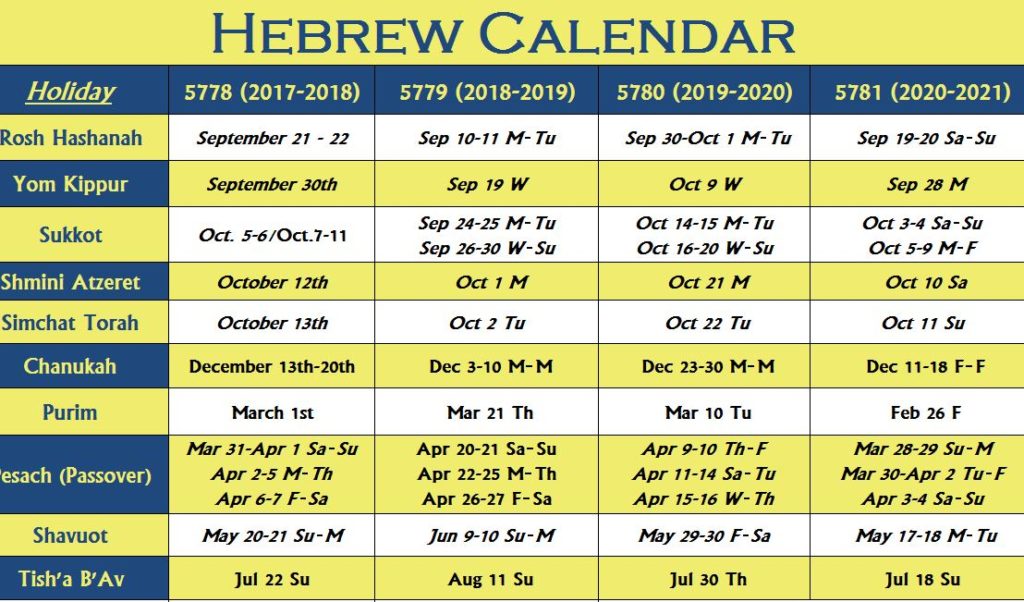
Hebrew Calendar Hebrew Holiday Calendar from exceltemplates.net New Year Celebrations Around the World
The New Year marks the start of a new year. It is the day on which the count is increased by 1. The New Year is celebrated in various cultures, but the Gregorian Calendar is the most widely-used calendar system. Read on to learn more about the traditions associated with this holiday. Don't overlook to indulge in some delicious food!
Respect
Each culture has their own traditions regarding the beginning of the year. A lot of people celebrate the new year by performing religious rituals. Buddhists and Hindus offer gifts to their elders. The Chinese give oblations to their gods. The celebrations are also a chance to exchange and receive positive wishes from your friends and family.
New Year's Day's roots can be traced back the seventh century, during which pagans commemorated the Annunciation. Certain religious leaders were opposed to the notion of celebrating the New Year's Day on the day Jesus was born. The custom of giving gifts on this day was established in Flanders, Netherlands in the 7th-century. The belief is that the celebrations of the new year were inspired by the Gregorian year. Julius Caesar also named the month Janus in honor of Janus, the Roman god of new beginnings. The god was capable of looking into both the past and the future from two different faces.
Modern New Year's Day celebrations are celebrated in a variety of countries on January 1 2019, 2019. The Gregorian calendar declares January as the day that begins the year. The start of the new year is in a different time in other calendars like the Julian. However, many cultures recognize the importance of celebrating the New Year and the new start it provides.
Traditions
There are thousands of different customs that mark the start of the new year. These celebrations can be found within individual households, cities, and cultures around all over the world. It doesn't matter if you have the traditional food, buy gifts for friends and family or even start a new business There are a variety of ways to begin your new year.
New Year's Eve celebrations typically start on December 31, and continue until the early hours of January 1. People love to eat foods that are good luck-related. For instance, grapes or legumes are thought to bring luck to those who eat them. Similar to that fireworks are lit to welcome the new Year in America.
Another tradition is eating of cabbage on New Years Day. It is believed that it will bring prosperity and cash for the coming fiscal year. The New York City's massive ball dropping in Times Square is an annual tradition. This event has been a part New Year celebrations since 1907. The massive sphere now weighs 12,000 pounds.
"Podariko" is a Mediterranean tradition that is commonly followed on New Year’s Eve. It is a term that means "good foot." This is due to the fact that pomegranates symbolize fertility and luck. Before the holiday the people place pomegranates on the door of their home. Lucky people are those who walk right into the house.
Religion
A lot of countries mark the New Year with religious celebrations. Japan is one instance. On Rosh HaShanaha, people present gifts to Buddhist monks. Chinese people celebrate the new year by offering offerings to the gods wealth, hearth and ancestors. In some parts of the world, the beginning of a new year is celebrated with an official holiday.
Orthodox Christians in the UK welcome the new year with liturgies and feasts. Many also attend blessings given by well-known Orthodox Christian leaders. Other celebrations include dinners, parties and meals for the community. Many people may set off fireworks to mark the start of a new year. Whatever type of celebration, it is an opportunity to rejoice in the start of the year.
Food
The New Year's Day dinner is a celebration of traditional food and festive food. The menu is usually lavish and extravagant, and can comprise Champagne and oysters. Other classic dishes include foie gras and smoked salmon. The principal course will typically be an entrée of chicken, such as turkey, goose or cornish hen (or some combination of the two) however, there are other choices. Other foods that are popular to serve for New Year's dinner include lobster or venison, as well as scallops.
These food items can be found in many cultures, even although they aren't required. Grapes are considered lucky in a variety of countries. Some people will eat the grapes every hour of the last day of the year. This symbolic gesture can bring you good luck in the new year.
In many areas of Asia fish is considered to be a symbol of abundance, prosperity and wealth. Japan is one illustration of this. Consuming herring on New Year's Day signifies that the coming year will bring prosperity. Pickled herring, which is also associated with abundance is also popular in Scandinavia. The Swedes believe that eating huge quantities of fish will bring them luck.
Holidays
Many cultures celebrate New Year's Eve by having special meals, celebrations, and customs. Many countries celebrate the New Year by eating symbolic food items like cabbage, which is considered to bring luck. Americans celebrate the holidays with poas that have black eyes, and are believed to be lucky. Asian cultures also celebrate the celebrations by eating special dishes. Many elaborate dishes use ingredients that are symbolic or appear in them.
The holiday period is a period of one to four days. The New Year's Day falls on the first day of January. The New Year in 2022 will be observed on a Saturday. This will mean that the period of celebration will be 3.25 days long.
Apart from the four bank holidays that celebrate the New Year there are many other bank holidays. A bank holiday of four days will be observed in 2022 to celebrate the Queen's Platinum Jubilee celebration. On the 28th of December, the day of Queen Elizabeth's birthday, the public can enjoy as long as three days off.
The time of year's close is a season of excitement. People are able to let go the past and concentrate on an exciting future. Additionally, students are allowed to leave classes. This is a wonderful opportunity to spend quality time with your loved ones.
Date
In most countries there are many countries where the New Year begins in January. It's a day of celebration and joy. People celebrate the New Year by singing, dancing and sharing gifts. It is the most well-known celebration in the world and its roots are from Babylon. The celebration was initially held for 11 consecutive days during the season of spring. This year's date is being moved to coincide with Jesus's birth.
Since 1582, the year that the Gregorian calendar was first adopted and the New Year date has fluctuated somewhat across the globe. Pope Gregory XIII, Pope Gregory XIII was the first Pope to change the calendar and moved the date of the New Year from the second day of January to preserve the equilibrium between the seasons. After a few years, 1 January was chosen as the date of the New Year.
Many other cultures also celebrate New Year's Day in other cultures. The Chinese celebrate the Lunar New Year in February 11th or 26th. Hindus observe the Hindu New Year on the 20th of February. The solar and moon cycles form the foundation of the Hindu calendar (also known as the Hindu panchanga). The Hindu calendar was developed in the year 57 BC and is based upon the seasons and days. The Hindu Year, which is a leap year and the date of its change is dependent on the leap year, is known as the Hindu Year.
Origin
The origins of the new Year aren't entirely clear. Some believe it came from the past of China. Based on Chinese mythology the mythical creature that had the head and body of an ox, and the body of a lion was in the ocean and emerged on New Year's Eve. It was scared of that it would be destroyed by fire, sound, red, and color. Chinese culture includes red canvases which are used to symbolize the beginning of the calendar year.
The Roman calendar of the Romans' early days had 10 months. Each lasted for 304 days. March 1 was the start of the year. In the early calendar, the ninth to twelfth moons were first called the seventh and tenth. Julius Caesar, an ancient Roman leader, developed an solar-based calendar. The calendar they used is like the one we have today.
Today we have many Asian cultures follow the calendar of the new year, which is the lunar calendar. It is still used in countries like China and Korea. The first new moon following the winter solstice signals the beginning of the new year.
The encyclopedia britannica, 1944 edition, vol. It consists usually of 12 alternating lunar months of 29 and 30 days each (except for ḥeshvan. The days of the week when passover can begin.
In Ancient Israel, The Civil Year Began.
With our free photo calendar maker, you can make a jewish holiday calendar 2022, 2023, 2024, and 2025 with 1, 2, or 3 photos on each page. The 1st of elul (6th month of the jewish. The hebrew traditions also have two other years, though this is not from scripture.
The Jubilees Calendar Is Further Divided Into Four Quarters, Each Of Which Consists Of 91 Days (13 Weeks Of 7 Days), And Since This Number Is Also Divisible By 7, Each Date In The Quarter Falls Out.
Years in the jewish calendar are designated am to identify them as part of the anno mundi epoch, indicating the age of the world according to the bible. It consists usually of 12 alternating lunar months of 29 and 30 days each (except for ḥeshvan. Adar ii is added in the 3rd, 6th, 8th, 11th, 14th, 17th and 19th years of the cycle.
Biblical Year Starting On Aviv/Nisan 1.
Therefore, the jewish new year starts in september, yes. That usually falls around the middle of september in the gregorian calendar. Scripture lists two names for the first month of.
The Earth’s Annual Orbit Around The Sun Is Divided Into 12.
The jewish civil year starts in the fall, in what is called the “7th month” in the bible (tishri). The days of the week when passover can begin. The civil year or civil calendar is determined from tishri.
The Time Of Year When The Length Of The Day And The Length Of The Night Are Equal.
You can either add generic. A jewish year the gregorian calendar system uses the year to determine the number and length of months. The hebrew year count starts in the year 3761 bce (before common era).
Share :
Post a Comment
for "When Does The New Year Start In The Jewish Calendar"
Post a Comment for "When Does The New Year Start In The Jewish Calendar"